Genomics 101: What is pharmacogenomics?
By Silvia Vannini onWhy do medicines work differently on different people?
Have you ever wondered why a medicine works well for one person but causes side effects for another? The answer isn’t always easy.
Age, lifestyle, underlying health conditions, and even our DNA can all play a role in how our bodies respond to medicines.
How can our DNA affect our response to medicines?
Good question! Our DNA can affect our response to medicines in a few different ways.
It might be that your body does not react, or overreacts, to a certain chemical which in specific medicines, making it potentially ineffective or dangerous to you.
Your body might also take more time to absorb and break it down once it enters your system. This might mean you need to be prescribed a different dose of the medicine, or a different medicine altogether.
So then, what is pharmacogenomics?
Pharmacogenomics studies how our DNA can affect the way we respond to medicines.
Our DNA is made up of sections that we call genes. These genes contain specific instructions that allow our bodies to function.
Variations in some genes, also known as genetic changes, can affect how we respond to certain medications in the ways we mentioned above.
What is pharmacogenomic testing?
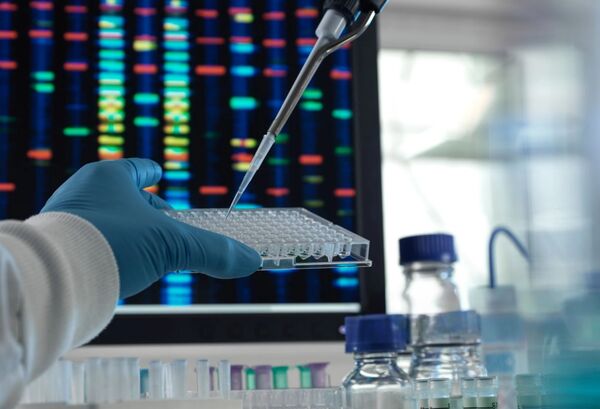
Pharmacogenomic testing can help scientists understand how genetic changes – or pharmacogenomic variants - can affect a person’s response to certain medicines. It usually involves a simple blood test, saliva sample, or cheek swab, which scientists will use to look at a person’s DNA.
Pharmacogenomic tests will look for something known as a gene-drug pair, which is when a specific genetic change is known to affect how a person will respond to a medication.
Do you have an example?
Sure! A well-known example of a gene-drug pair is the CYP2C19 gene, and a medicine called clopidogrel.
If somebody has a stroke, the usual practice is to offer them clopidogrel to stop their blood from clumping together and prevent further strokes in the future.
However, certain changes in a gene called CYP2C19 can affect the way that people process this drug in the body.
By testing the CYP2C19 gene, we can obtain information as to whether somebody should be given a standard dose of the drug, or whether it is less likely to be effective for them.
Is pharmacogenomics already being used in day-to-day healthcare?
Yes! But not yet on a wide scale.
Today, pharmacogenomics is mainly used in specialised areas of healthcare and for specific groups of patients. One example currently available in the NHS is the DYPD test.
DYPD is a gene that produces a protein which helps to breakdown certain types of chemotherapy drugs. People with very low levels of this protein are more likely to experience serious side effects of these chemotherapies.
By doing a DYPD test before the treatment starts, patients and their clinical teams can discuss ways to reduce risk of serious side effects, such as starting off with a lower dose.
Why is pharmacogenomics important?
Choosing treatments that are specific to individual patients could not only make treatment more effective and reduce side effects; but it also has potential to reduce the pressure on the NHS.
Adverse drug reactions, meaning bad reactions to drugs, account for around 1 in 16 hospital admissions, and have been estimated to cost £2.2 billion every year.
Using pharmacogenomics to reduce these adverse reactions, improving a patient’s quality of care whilst also relieving pressure on the NHS.
What’s the future of pharmacogenomics?
As genomics becomes a bigger part of healthcare, conversations about pharmacogenomics are becoming more and more important.
The UK Government's 10 Year Health Plan set out an ambition for Genomics England to deliver a new research study that will involve 150,000 adults. The study aims to explore how pharmacogenomics could help identify health risks earlier and support more personalised healthcare.
There is still work to do before pharmacogenomics becomes part of routine care, but advances in genomics are creating new opportunities for care that is specific to an individual’s genetic makeup.
As healthcare becomes more personalised, pharmacogenomics might help us move away from a one-size-fits-all model, and towards treatments that can be specific to an individual’s unique DNA.
And finally...
If you want to learn more about genomics, check out our other explainer blogs.
You can also listen to our Genomics 101 podcast episodes, where we talk to experts about important topics in research and healthcare.