The Participant Panel celebrates its 10th anniversary
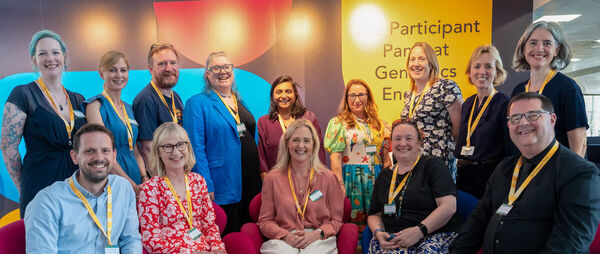
The Participant Panel, an independent and key advisory group for Genomics England, is celebrating its 10th anniversary. This major milestone marks a decade of championing participant voices and helping shape the future of genomic medicine and research in the UK.
What is the Participant Panel?
The Participant Panel represents the interests of the thousands of people whose data is held by Genomics England in the National Genomic Research Library (NGRL). It was formed in 2016 to place participant voices at the heart of Genomics England’s work, governance and strategic decision-making. It’s made up of a diverse group of people who have consented to donate their own or a family member’s data to the NGRL and who bring their experiences of rare conditions or cancer.
Since the Panel’s establishment, it has grown in size and impact while continuing to work tirelessly to put participants at the forefront of research efforts and decision-making, including guiding decisions regarding access to and use of participant data through representation on Genomics England’s committees.
Building a foundation and culture for success
For Kirsty Irvine and Helen White – the Panel’s Chair and Vice-Chair for Cancer respectively – a key reason for the Panel’s success has been the groundwork laid during its early days and the culture at Genomics England. Helen, a longstanding Panel member, credits a culture of empowerment and support: “From the outset, Panel members were empowered to speak up, supported to contribute and made to feel like true partners rather than an add-on. That early culture set the tone for everything that’s followed.”
Kirsty also points to this organisational culture as fundamental to the Panel’s success: “It's the respect that the organisation has for the participant voice. I don't feel like it's lip service. I don't feel like it's a box ticking exercise. I genuinely feel that it is embedded in the culture from the board down. That’s created the right environment for the Panel to flourish.”
Ten years of impact
During its first decade, the Participant Panel has had a significant impact, from publishing influential papers in peer-reviewed journals to helping shape recruitment and consent materials for major genomics research programmes, to name but a few of its accomplishments.
Adam Clatworthy, Vice-Chair for Rare Conditions, says that while many projects could be referenced throughout a decade of achievements, “perhaps one of the most significant impacts on the participant experience was the ‘Check My Choice’ initiative and the Panel’s sustained advocacy for it.”
The Panel’s advocacy led to NHS England agreeing to send out Check My Choice letters for Additional Findings - additional health information in the genome sequence of participants. Instead of only contacting those with a finding, all participants were reminded of their choice and given the opportunity to confirm or change it before results were returned. More than 76,300 participants were contacted, with over 12,000 responses received and hundreds altering their choice.
Kirsty concurs, adding: “It might sound simple, but communicating with that many participants was a huge achievement not often seen with other national research programmes at that scale. It really was a key achievement.”
Another major contribution from the Panel was the Language and Terminology Guide published in 2022. This guide aimed to help professionals speak about disability, cancer, and genetic conditions in more respectful and inclusive ways. It has since influenced practice beyond Genomics England and has been widely referenced by clinicians and researchers.
What does the future hold for the Participant Panel?
Panel members have spoken of the community and sense of belonging they have found through joining, and the platform it’s given them to ensure other families don’t have to carve their own paths alone. Adam reflects that being on the Panel has “been a way to turn my grief into a purpose.”
For Helen, with so much of the Panel’s success owed to its authenticity, protecting its foundations is essential: “Those of us on the Panel now won’t still be on it in ten years’ time, but we haven’t forgotten the work of the Panel’s initial pioneers, whose work underpins everything that has followed. I’d hope that in another ten years, it still hasn’t forgotten its roots.”
At the same time, both Helen and Kirsty are clear that the Panel must continue to change alongside the participant community it represents. Helen notes that she would like to see it becoming more representative of the population it represents, and Kirsty emphasises that evolution is not optional: “As the National Genomic Research Library grows, so will the community of participants. The Panel must keep evolving if we’re going to continue to meet the needs of those different cohorts and be effective advocates.”
The Participant Panel launched its refreshed strategy last year to align with and support the wider goals of Genomics England. Looking further ahead, Adam remarks: “Our vision for the next decade is centred on moving from a supportive role to becoming a primary engine of accountability and co-production.” For Panel members, this means being involved earlier and helping shape strategy, services and research priorities from the outset. As Kirsty puts it, “We’d love to be able to expand our reach of who we work with and try to put the participant voice across the entire lifecycle of the genomics sector.”
"Genomics England puts participants at the heart of everything we do. The Participant Panel has been imperative to this. Over the past ten years, their perspectives, lived experiences, and guidance have all been invaluable in shaping what we do and ensuring the interests of patients and participants underpin everything we have achieved.
“I’d like to thank all Panel members, both past and present, for giving us their time and expertise and congratulate them on all their successes. We’re excited to continue working closely with the Panel as we aim for a world where everyone benefits from genomic healthcare."
Dr Rich Scott
Chief Executive Officer of Genomics England
To find out more about the Participant Panel and its work, visit its dedicated webpage.