Genomics 101: What are dominant and recessive genes?
By Florence Cornish onIn this series, ‘Genomics 101’, we go back to basics and explore some of the most important topics in genomics. In this blog, we explain the meaning of dominant and recessive genes, and how they are different from each other.
First things first, what is a gene?
A gene is a section of DNA that contains a specific instruction for our bodies. This instruction provides information about how we develop, function or grow.
For example, humans have genes that determine our eye colour. The DNA sequence in these genes codes for a certain amount of pigment to be produced.
People with genes that code for lots of pigment will likely have brown eyes, and people with genes that code for less pigment will likely have blue eyes.
How many genes do we have?
Scientists aren’t completely certain on the exact number of genes we have, although estimates suggest around 20,000 pairs.
One gene from each pair comes from our mother, and the other one comes from our father. Collectively, they make up who we are and how we function.
Are both genes in each pair the same?
Not exactly. Whilst both genes in a pair contain information about the same instruction, the DNA sequence in each gene will slightly differ.
If we think about the example of eye colour from above, both genes in the pair will code for eye colour, however, one might code for blue eyes, and the other for brown eyes.
In this specific case, the person will most likely have brown eyes, because the gene for brown eyes is what we call ‘dominant’.
What exactly is a dominant gene?
If a gene is dominant, there only has to be one copy present in the pair for it to be expressed.
This means that if a parent passes on a dominant gene to their child, the child will most likely express it, regardless of which gene is inherited from the other parent.
You might sometimes hear this referred to as the dominant gene ‘masking’ the other gene in the pair.
Some commonly used examples of dominant genes in humans are brown eyes and freckles, as well as various genetic conditions, such as Huntingdon’s and Marfan Syndrome.
So then, what is a recessive gene?
A recessive gene requires 2 copies to be present, so both genes in the pair, in order to be expressed.
If a recessive gene is inherited alongside a dominant gene, the recessive gene will be ‘masked’, but if it is inherited with another recessive copy, it will be expressed.
If we look back at the eye colour example, we know that people with blue eyes must have therefore inherited the recessive blue eye colour gene from their mother, and from their father.
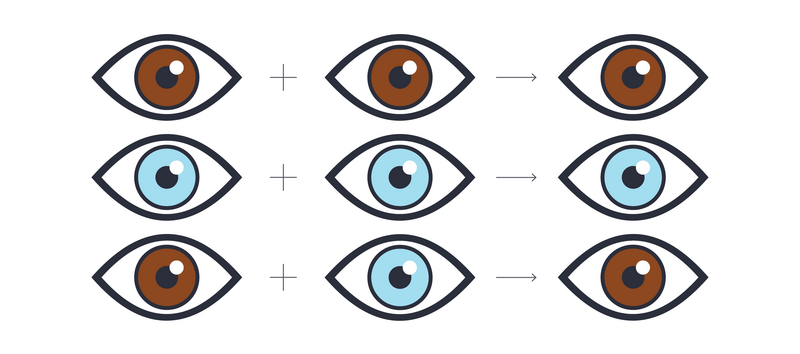
Figure showing the inheritance pattern of brown eyes vs blue eyes
Are all genes dominant or recessive?
In short, no, not all genes fit into the categories of dominant and recessive. There are many other ways that genes can be expressed, and we call these ‘patterns of inheritance.’
Some examples of other patterns of inheritance include:
1) Codominance - where both genes in the pair are fully expressed
A key example of a codominant trait is blood group. People who inherit one gene for blood group A and one gene for blood group B will have the blood group AB.
2) Incomplete dominance – where both genes blend together to produce an intermediate
Many traits in humans are a result of codominant genes, but a well-known example is wavy hair, which can arise as an intermediate of curly hair and straight hair genes.
3) Polygenic inheritance – where a single trait is influenced by lots and lots of different genes
The vast majority of our traits follow this polygenic pattern of inheritance, with height and skin colour being amongst the many examples.
Whilst all of these patterns might sound complicated, the take home is that genes can affect the way we look and function in lots of different ways!
That’s why genomic research is so important, to help us better understand how our genes can affect our health.
How does this relate to genetic conditions?
As we mentioned earlier, children inherit genes from both of their parents.
This means that if one of the parents has a gene that causes a condition, there is a chance that this gene gets passed on to their child.
However, as discussed above, just because a child inherits a gene, it doesn't always mean that the gene will be expressed! This depends on lots of different factors, including the patterns of inheritance that we mentioned above.
If you want to learn more about this topic, we cover it in more depth in a previous Genomics 101 blog: Are genetic conditions always inherited from parents?
And finally...
If you want to read about more topics in genomics, check out the other blogs on our website.
You can also listen to our Genomics 101 podcast explainer series.