What has our Research Network achieved in 2026?
By Xan Sieghart onEvery year, we ask researchers who use the National Genomic Research Library (NGRL) to tell us how their projects are progressing and what they have achieved.
The results help us understand how researchers are using the data in the library, where projects are making an impact, and how we can continue to support our Research Network.
This year’s audit paints a positive picture. Research activity continues to grow, projects are producing valuable outputs, and researchers around the world are using the NGRL to make new discoveries about rare conditions, cancer, and other areas of health.
Active and engaged researchers
This year, the audit covered 702 projects from across our Research Network, a community of over 1,500 researchers from academia, healthcare and industry.
Researchers remain highly engaged with the audit process, as we achieved record-breaking response rate of 97%.
Results show that most projects remain in progress, reflecting the long-term nature of genomic research. Many studies take years to move from an initial research question through to data analysis, validation and publication.
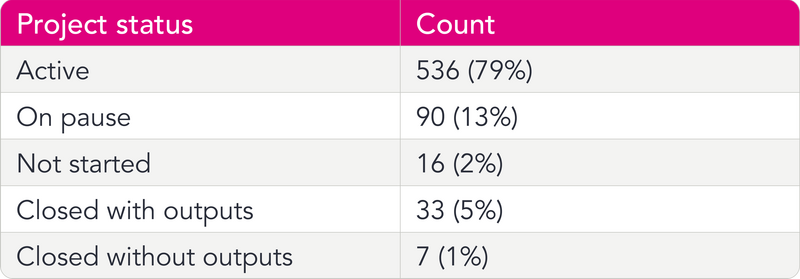
Status of research projects in 2026 audit
Where projects have paused, researchers most commonly cited reasons such as changing priorities, funding challenges, and changes in the research team. These changes included students completing their projects, and researchers moving to new positions.
These findings are consistent with wider pressures across the research sector, and show that the biggest barriers to progress often sit beyond our control.
Strong publication and funding performance
Data from the NGRL has supported 208 papers published in the last 12 months, including 32 papers in high-impact journals such as Cell, Nature and The Lancet Oncology.
Notable examples include a Nature Genetics study that used data from the NGRL to identify a previously under-recognised cause of retinitis pigmentosa, a rare inherited eye condition that can lead to sight loss.
By analysing genomic data from a large number of participants, researchers showed that genetic changes in a specific group of genes can contribute to the condition, helping provide answers to families who had previously remained undiagnosed.
You can find the published paper here.
The audit also showed success in attracting funding. Collectively, researchers reported securing over £70 million through 116 funded grants. This represents a substantial increase compared with previous years, and reflects both continued UK investment and growing international support for research using NGRL data.
Funding is an important measure of confidence in a research area. It enables research groups to recruit staff, generate new evidence, and pursue ambitious scientific questions.
Impact beyond publications
Publications are one of the most visible outcomes of research, but they are only part of the picture.
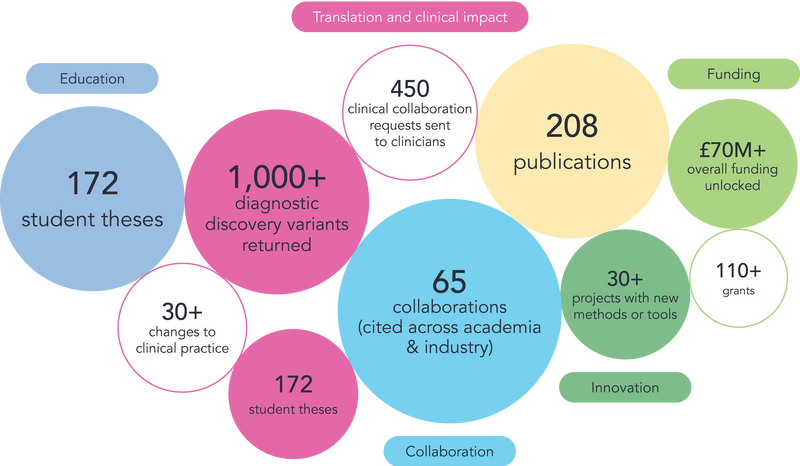
Snapshot of 2026 research outputs
This year's audit revealed a wide range of outputs from academic and industry researchers. These include student research projects, conference presentations, new collaborations, innovative methods and tools, clinical trial activity, intellectual property, and changes to clinical practice.
Researchers reported that projects led to direct benefit for patients and healthcare services. For example, new clinical guidance on how to monitor familial chordoma, a rare type of bone cancer. Another reported that whole genome sequencing had been adopted for all MRD testing, an ultra-sensitive test to detect tiny amounts of tumour DNA.
These findings highlight an important point. Research impact is not a single event. It often develops through many different outputs, each building knowledge, skills, collaborations and evidence that can ultimately improve healthcare and further research.
Understanding patient and public involvement
Alongside research outputs, the audit also explores patient and public involvement and engagement (PPIE). This is an important area to understand, because it provides insight into how researchers are incorporating the perspectives of patients, participants and the wider public, helping to ensure that research remains connected to the people it is ultimately intended to serve.
In the audit, we use NIHR definitions to distinguish between involvement and engagement. We found that levels of PPIE remained broadly stable compared with last year. Researchers reported a range of activities, from discussing research with members of the public and working with charities, to involving patients in priority setting, providing feedback and supporting advisory groups.
The audit also helps us understand why some projects have not yet used PPIE. In many cases, researchers explained that their projects were still at an early stage or focused on foundational scientific questions where the most appropriate form of involvement was not always clear.
These insights will help inform future guidance and support for researchers across the Research Network, about how they can include meaningful and proportionate PPIE in their projects.
And finally...
If you want to read more about what our Research Network achieved this past year, checkout our news page.
You can also learn more about the Research Newtork in a previous blog.