Safi's story: Isolated growth hormone deficiency
Safi is just over a year old and from Cambridge. She is one of the babies taking part in the Generation Study and was found to have a genetic change associated with a growth hormone deficiency shortly after birth.

About isolated growth hormone deficiency
Isolated growth hormone deficiency is a condition caused by a severe shortage or absence of growth hormone.
The main symptom is
growth being affected leading to being much shorter on average.
Between 60 and 150 babies
are born in the UK each year with isolated growth hormone deficiency.
Safi’s story
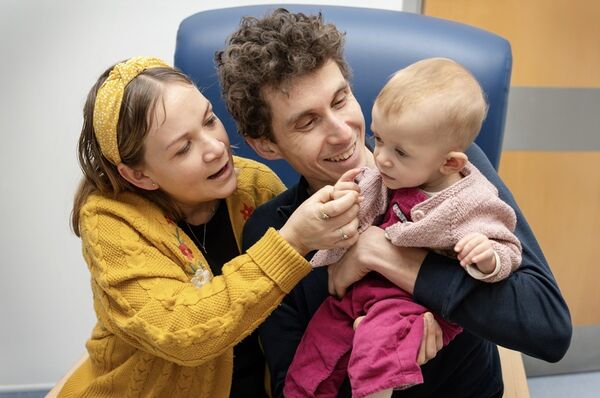
Safi was born at the Rosie Hospital in Cambridge in December 2024. Safi’s mother, Dorka, had signed up to the Generation Study when Dorka was pregnant. The Generation Study is a research study led by Genomics England in partnership with NHS England that is sequencing the genomes of 100,000 newborns to understand whether we can improve our ability to diagnose and treat genetic conditions.
Dorka joined after learning that isolated growth hormone deficiency was one of the more than 200 rare genetic conditions the study is looking for. There’s a family history of the condition on Dorka’s side - with her, her father, and her brother all being diagnosed with it. It was important to her that if Safi had the condition, she received treatment as soon as she could. Dorka says: “I didn’t start treatment until I was 17 and by then it didn’t make a huge difference to my height. I’m about 4’10” now. I would have liked to have started sooner and I’m glad that Safi will get that chance.”
The benefits of a diagnosis
Safi received her diagnosis within a few months of being born and started treatment in the summer of 2025. She receives a daily injection which will continue up until she’s around 25 years old. Since starting treatment, Safi has grown over 15 centimetres and it’s predicted that, if treatment continues, her adult height will be within the typical range and unaffected by IGHD.
Dorka is happy to have taken part in the study which has had several benefits: “I would 100% encourage others to either join or at least consider it,” she says. “It meant a lot to us to have a speedy diagnosis and for Safi to be treated sooner.
“It’s also a much better experience for Safi. When I was tested for IGHD it was unpleasant, involving time in hospital and lots of blood tests. I wouldn’t have wanted that for Safi and we’d probably have to have waited until she was older before she could be tested.
“For the genetic test, they just collected a blood sample from her umbilical cord after she was born and sent that off. When we got the results, it provided evidence for her to be diagnosed and start treatment.”
While Dorka knew during pregnancy there was a chance of Safi having isolated growth hormone deficiency and had planned to test her for it regardless, she understands that the benefits of whole genome sequencing as part of screening could be even greater for those without that anticipation of a possible condition. She says: “Without my family history, it would have been a much worse journey for me emotionally to not know why Safi was having her issues. I’d have seen her being well behind on the average growth charts and wonder if it was something I was doing wrong or if there was a problem with feeding – it would have been so hard. A proper diagnosis gives you the ability to say ‘okay, I know why this is now’, which removes a lot of anxiety.
“I’m grateful for the opportunity to take part in the Generation Study and I hope treatment will make Safi’s life much easier as she gets older.”